Make sure the education that your child was promised is what they’ll get.
Parents! Don’t Waste Your Money!
Before you enrol your child, learn how to check whether a school, a homeschool, or an online provider can deliver the qualification it promises.
Imagine this…
You’ve found what seems like the perfect school for your child. The website looks good, the fees are affordable, the communication is friendly, they’ve assured you they are a CAPS curriculum provider, and your child will get a matric certificate at the end of the road.
That sounds fantastic, doesn’t it?
But here’s the thing, it may not be fantastic at all. In fact, it may be a terrible mistake.
Have you checked whether that school is actually registered to offer what it promises?
A beautiful classroom does not make a registered school. A CAPS curriculum does not guarantee an NSC. And a certificate with the word matric printed on it does not automatically make it a National Senior Certificate.
By the time you discover that something is wrong, the damage is done.
You’ve possibly spent years paying school fees only to discover that your child’s Grade 11 results cannot be accepted for entry into the National Senior Certificate (NSC) programme. Or, even worse, your child proudly submits their “matric” certificate only to have their application turned down because they don’t have an NSC.
The financial loss is devastating; even worse is the impact on your child’s education and future opportunities.
The good news? You can protect yourself!
Whether you’re considering a traditional school, homeschooling, or distance education/online education, there are important questions you need to ask and documents you need to check before signing those enrolment forms or paying a cent.
I’m Lio, and I’m here to help you separate genuine educational opportunities from costly misleading promises.
Keep a lookout for more of my Lekker Tips!
Because when it comes to your child’s future, a little research today can prevent a very expensive mistake tomorrow!
What is a Real Matric?
Not every certificate that is advertised as a “matric” certificate is a National Senior Certificate (NSC).
The NSC is South Africa’s recognised school-leaving qualification. It’s quality assured and certified by Umalusi. Umalusi is the Quality Council responsible for general (grades 7-9) and further (grades 10-12) education and training qualifications.
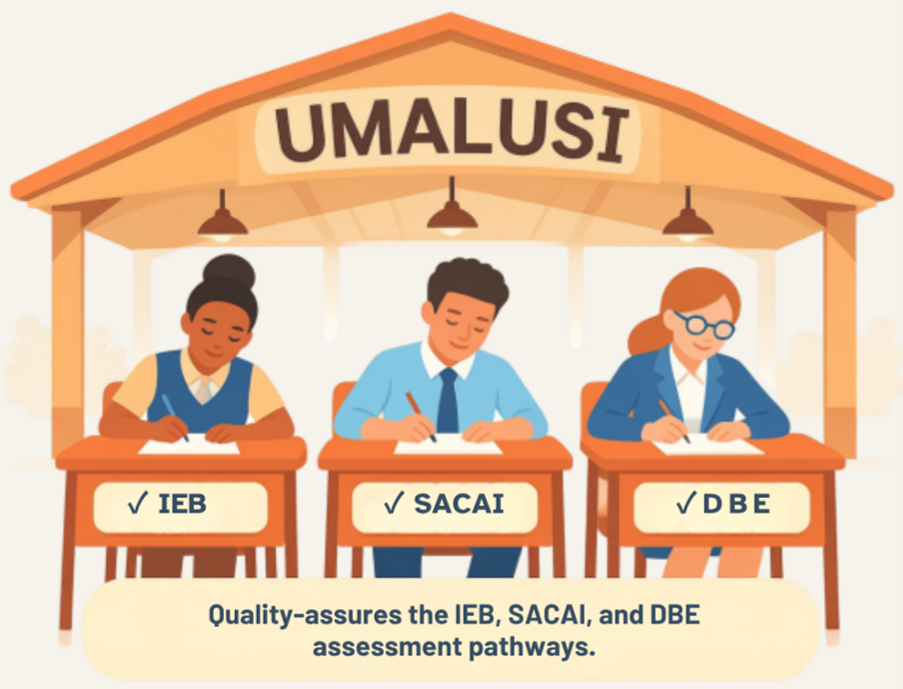
There are three assessment bodies through which a school learner can get their NSC:
The Department of Basic Education (DBE): The DBE is responsible for public and independent school NSC exams.
The South African Comprehensive Assessment Institute (SACAI): SACAI is a private assessment body for distance education providers and private schools.
The Independent Examinations Board (IEB): The IEB is a private assessment body for distance education providers and private schools.
Regardless of which of these assessment bodies is responsible for your child’s final matric exams, the final qualification is the NSC, provided your child meets the requirements.
But what about matric alternatives?
There are legitimate alternative pathways to the NSC. They are often called “matric equivalents” or “school leaving certificates.” However, the legitimate ones are still registered with their own examination bodies.
Lio’sLekker Tip
Different pathways have different registration and recognition requirements. Know which ones apply before you pay.
Alternative qualifications offer genuine education pathways, but they are not the NSC and their recognition for further study, employment, or university admission depends on the individual application requirements.
Some legitimate examples are:
The Senior Certificate: registered with Umalusi and the Department of Higher Education (DHET)
The American General Education Development (GED) qualification: recognised by the South African Qualifications Authority (SAQA)
The Cambridge IGCSE and AS Levels: accredited by Cambridge University
Neither pathway is the “correct” way for everyone. What matters is that whatever pathway you choose, must be able to deliver on what it has promised you.
Lio’sLekker Tip
If a provider promises your child a “matric,” ask them one simple question: Will my child receive an Umalusi-issued National Senior Certificate, or a different qualification?
Know the difference before you enrol.
Who Regulates Your School?
Here’s where things can get a little confusing. A school tells you it’s registered, another says it’s accredited, and an online school claims to be CAPS compliant. But what does any of that actually mean?
In South Africa, different organisations play different roles in making sure learners receive a recognised education.
Let’s break it down.
Umalusi: The Quality Council
Think of Umalusi as the roof over South Africa’s three NSC exam pathways. Umalusi is responsible for quality assuring the NSC, accrediting private assessment bodies and qualifying private education institutions, and issuing NSC certificates to successful candidates.
DBE: Department of Basic Education
Public schools fall under the government’s education system, with national oversight from the DBE and provincial administration through the provincial education departments. The DBE is responsible for all public-school learner’s exams. Provincial education departments are responsible for registering independent schools in their provinces.
IEB: Independent Examinations Board
The IEB is an independent assessment body accredited by Umalusi. It conducts NSC assessments for learners at affiliated private schools.
SACAI: South African Comprehensive Assessment Institute
SACAI is another independent assessment body accredited by Umalusi. It assesses learners pursuing the NSC through registered independent schools and distance education providers, including online education programmes.
Do you see how they connect?
A physical independent school must be registered with its provincial education department and meet the Umalusi accreditation requirements.
A distance education/online provider is registered with SACAI or the IEBwho facilitates the NSC learning pathway. SACAI is accredited with Umalusi, not the distance education provider.
Lio’sLekker Tip
When an institution says it’s registered or accredited, don’t just take its word for it.
Ask: Registered with whom? Accredited for what? And where can I check?
Because a registration number means very little if it cannot be independently verified.
Check Your Physical School
An office, classrooms, a principal, and timetable all look very professional and trustworthy but that does not mean the school is registered.
Before you pay, check the paperwork!
If an institution calls itself a learning centre, tutoring centre or education facilitator, don’t automatically assume it is a registered school.
These centres may offer valuable educational support without being registered independent schools. However, they must not misrepresent the educational services or qualifications they are authorised to provide.
Ask who is responsible for your child’s official enrolment, curriculum, assessments and qualification, and whether the arrangement complies with the relevant requirements.
Lio’sLekker Tip
We work with LOTS of these places all around South Africa! Auxilio is the curriculum provider, we are registered with SACAI. SACAI is accredited with Umalusi.
Remember, a curriculum provider’s credentials are not automatically the credentials of the centre using its materials.
If they call themselves a school, then they need to meet certain requirements.
When you have all the information from the school, verify it for yourself.
They must have a provincial registration certificate. This certificate proves the provincial education department registered the school, at a specific address and for specific grades.
They must have and EMIS number. An Education Management Information System number is like your ID number. It identifies the school in the education system. You can search the EMIS number on the Lurits website to see if the school is telling you the truth!
If it is an independent school, it must have Umalusi accreditation. This is very easy to check. Umalusi’s website tells you if the school is accredited, what grades they are allowed to offer, and who the owner is!
The school must be able to identify its recognised NSC assessment body (DBE, SACAI or IEB) and provide verifiable information about its examination registration arrangements.
Lio’sLekker Tip
Don’t just ask a school, “Are you registered?” Get their details and do some fact checking.
A school’s appearance may impress you, but its paperwork should reassure you.
What About Homeschooling?
In South Africa, homeschooling is a legitimate choice! But, as a parent, you need to understand your responsibilities and how they change as your child progresses through the grades.
Know your responsibilities!
Mainstream schooling is not for everyone. Not every child fits into the brick-and-mortar school model and they need the flexibility that homeschooling offers.
The biggest issue around homeschooling happens when parents misunderstand the law or providers misrepresent themselves and the child gets disadvantaged.
Buying a curriculum package does not automatically mean your child is officially registered for home education or that they will receive a recognised qualification at the end.
Grades R-9: Who is responsible?
YOU.
If you are homeschooling your child for these years, you are responsible for registering them with your Provincial Department of Education. The Department of Basic Education offers detailed insight into what your day-to-day responsibilities are on their website, including the application form. If you’d like to read the Policy on Home Education have a look at it here.
You are responsible for your child’s learning, monitoring their progress, and arranging for a competent assessor to assess their educational achievement at the end of each phase (Grades 3, 6, and 9). These assessments must demonstrate that your child is achieving a standard of education that is not inferior to the National Curriculum Statement.
You can choose to get assistance for your child from a learning centre or from a distance education provider to get a curriculum and assessment package. BUT seeking assistance from them does not shift any of the responsibility to them, it still lies with you.
Lio’sLekker Tip
Ask your curriculum provider: “What exactly are you providing, and what am I responsible for registering and managing myself?”
Any provider who knows (and follows) the law will be able to give you an honest answer that does not change when the pressure is on!
Grades 10-12: Matric Matters!
This is where things get serious.
If you want your child to finish school with a National Senior Certificate, then they MUST follow a recognised NSC pathway from Grade 10. And yes, homeschooling can be done in grades 10 to 12!
The NSC involves more than simply passing a final Grade 12 exam. Learners must complete the appropriate curriculum and assessment requirements across Grades 10, 11, and 12, including SBAs (School-Based Assessments/Site-Based Assessments) and applicable practical and oral assessments.
For home schoolers, this means registering with an education provider recognised by the relevant NSC assessment body.
The Amended Schools Act specifically requires parents intending to pursue the NSC to ensure that the learner meets the relevant requirements before beginning studies after Grade 9. This means they must start the NSC pathway in Grade 10.
Remember the ONLY recognised National Senior Certificate assessment bodies are: SACAI, the DBE, and the IEB.
Imagine your child completes Grades 10 and 11 through a curriculum supplier. They’ve had a great time. You’ve trusted them. Your child has received excellent reports!
Then you discover that those reports cannot be verified or accepted for entry into an NSC Grade 12 programme…
Two years of hard work and school fees are wasted.
That does not mean a learner can never transfer between legitimate education providers. It means parents must ensure that academic records and assessments meet the requirements of the receiving institution and assessment body.
Lio’sLekker Tip
Homeschooling is not the problem. Unverified registration and assessments are.
If your goal is an NSC, make sure your child’s qualification pathway is legitimate from Grade 10, not just when matric examinations arrive.
Is Online Learning Legitimate?
Online learning is very popular, and why not? You get to learn from wherever you are most comfortable.
Unfortunately, there are some “online schools” out there that use confusing marketing language that leaves parents believing they are paying for a recognised NSC pathway when they may only be purchasing a curriculum package.
Lio’sLekker Tip
Paying a legitimate provider once may be considerably cheaper than paying an unregistered provider and then having to start again.
Anyone can create a website, upload lessons, make a test, and call their business an online school. That doesn’t automatically make them a recognised NSC provider.
Umalusi doesn’t currently register or accredit online schools. Instead, online and distance education providers offering the NSC must comply with specific requirements through the relevant recognised assessment body, such as SACAI or the IEB.
So, what should you check?
Before enrolling your child, especially for Grades 10 to 12, ask the provider these questions:
1. Who are you registered with, and are you registered to offer my child’s grade this year?
If the provider offers the NSC pathway, ask for the registration details and verify them with the assessment body. A provider appearing on a recognised list does not necessarily mean that every grade is covered.
For example, Auxilio is registered with SACAI as a distance education provider under registration number 803301 for Grades 10 to 12 and Repeater Candidates. You can double check this on SACAI’s website.
2. Who registers my child?
Ask who officially registers your child for the NSC, and how you can confirm that registration has been completed. Don’t assume that paying your enrolment fees means your child has been registered for the qualification!
3. Who manages assessments?
The NSC requires SBAs, including tasks, tests, exams, practicals, and orals. It is important to know who sets and marks the assessments as well as who records and submits these results.
4. Where will my child write their exams?
The final NSC examinations must be written at an approved physical examination centre. Ask how you will receive confirmation of your child’s examination registration, exam number, and physical writing arrangements.
5. What qualification will my child receive?
Ask whether your child will receive an Umalusi-issued NSC or a different qualification. Make sure you understand exactly what you’re paying for.
Lio’sLekker Tip
Ask: If I enrol my child with you today, who takes responsibility for ensuring my child is correctly registered and will be able to receive a recognised qualification at the end of the year?
Too Good To Be True?
Everybody loves a bargain, especially when it comes to school fees! Finding an affordable option can feel like winning the lottery.
But a bargain is only a bargain if you get what was promised.
Affordable education is wonderful, unverifiable education is a gamble.
There is nothing wrong with affordable education. But when someone is offering a “matric” for a suspiciously low price, do your homework. Equally, expensive schools are not automatically legitimate either!
Lieutenant Lio reporting for Red Flag Patrol!
Look out for these red flags from providers:
1. Guarantees a matric certificate: No legitimate provider can guarantee your child will pass the NSC.
2. Promises a quick or easy matric: The NSC has very specific standards for assessment and exams. There are no shortcuts to getting an NSC!
3. Cannot provide registration details: If they cannot or do not want to provide their registration details, something is wrong. Their registration details should be displayed for everyone to see! They’re something to be proud of!
4. Avoids questions about examinations: If they cannot answer your questions easily with documentation to back it up, it’s time to back off.
5. Claims accreditation without proof: SACAI, the IEB, and the DBE all display their registered institutions proudly. If you cannot find proof of registration, it might not exist.
6. Pressures you to pay immediately: Be careful when an institution or provider insists that you pay anything before you get a chance to verify their credentials.
Lio’sLekker Tip
A too good to be true cheap education can become very expensive. Cheap doesn’t automatically mean dodgy and expensive doesn’t automatically mean legit!
Before you hand over your hard-earned money, verify the promises being made to you!
If the school closed tomorrow, could you prove that your child was officially registered and that their academic results were recognised?
Now You Know
Choosing a school, homeschool programme, or online education provider is a big decision. You’re not only choosing where your child will learn. You’re trusting that provider with years of your child’s education, your money, and ultimately, their future opportunities.
This is why you should never feel uncomfortable asking questions.
Lio’sLekker Tip
A legitimate provider should welcome your questions, not fear them.
Your child’s education is too important to leave to chance. Ask questions, check the paperwork and verify before you pay!
And remember, the most important questions of all:
“If I enrol my child with you today, who ultimately takes responsibility for ensuring that my child is correctly registered and able to receive a recognised qualification?”
Your child can recover from choosing the wrong textbook. They can change teachers. They can even change schools.
Recovering from two or three years spent on an educational pathway that does not lead to the qualification you thought you were paying for is far more difficult.
Lio’sLekker Tip
You do not need to know every education regulation in South Africa.
You just need to know enough to ask the right questions, check the answers, and refuse to accept “just trust us” as proof.
A professional-looking website does not prove that a provider can legally take your child through matric.
So, before you enrol, before you sign, and before you pay:
Check the paperwork. Verify the promises. Protect your child’s future.





Leave a Reply